by
by 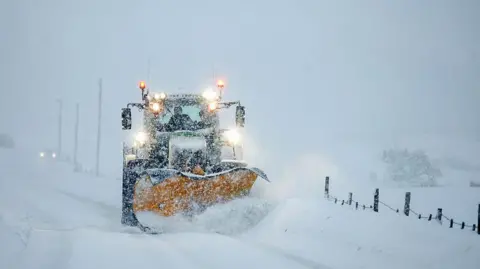
The UK is braced for widespread heavy snow and strong winds as Storm Goretti moves across the country on Thursday.
The Met Office, which describes the storm as a “multi-hazard event”, has issued an amber warning for snow and heavy winds in parts of England and Wales, and a number of yellow weather alerts across large swathes of the UK.
Officials in the Midlands are preparing for the “worst snow in a decade” with as much as 30cm (11in) expected to fall, while gusts of 90mph (144kph) could batter exposed areas.
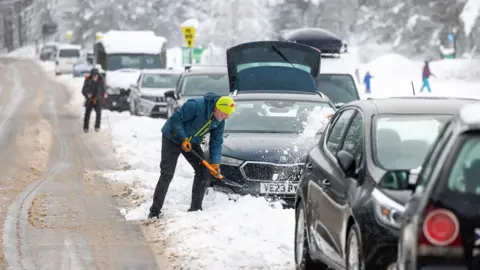
The AA has urged drivers to take “extreme care” after days of cold weather gripped the country.
Storm Goretti, named by French forecasters, is currently developing rapidly in the Atlantic with a huge cloud shield now covering much of Northern Ireland, England and Wales.
The storm is likely to undergo “explosive cyclogenesis” or “weather bomb” – a term used where central pressure drops by 1 millibar (mb) an hour over a 24-hour period, generally resulting in particularly powerful gusts of wind over a period of a few hours.
Rain will spread gradually north and east across much of England and Wales. Winds will strengthen in south-west England and snow will start to fall as the rain hits the cold, Arctic air on Thursday afternoon into the evening.
Neil Armstrong, chief forecaster at the Met Office, described Goretti as a “multi-hazard event” that will bring heavy rain, strong winds and snow.
Between 5cm and 10cm of snow is expected widely in Wales and the Midlands, he added, with 15-25cm and a potential for up to 30cm in some areas, especially on the hills of Wales and the Peak District.
In the West Midlands, local authorities said they were preparing for potentially the worst snowfall in a decade.
Parts of Cornwall and the Isles of Scilly could see gusts of up to 90mph, bringing the risk of falling debris and potential danger to life.
Heavy rain could also bring some localised flooding to parts of south-west Wales and eastern England.
Snow and rain will begin to ease on Friday morning, but with snow on the ground, there’s likely to be some travel disruption for the morning commute.
Live updates on this story
The AA has urged drivers to consider delaying journeys or work from home if possible, as wintry conditions could “reduce visibility in seconds” leading to familiar routes becoming “hazardous very quickly”.
Drivers are being asked to take “extreme care” due to the risk of black ice, after nine children were injured in a collision between a school coach and a bus in Reading on Wednesday.
Rail passengers have been advised to check their journeys ahead of travelling on Thursday and Friday as a number of National Rail services are likely to be suspended or disrupted.
A number of service providers including Avanti West Coast, Transport for Wales and CrossCountry services will be running fewer trains on some of their routes from 15:00 on Thursday, with some cancellations.
East Midlands Railway says it will not be running trains from both directions between Manchester Piccadilly and Sheffield after 18:00 on Thursday and all day Friday. No replacement buses will be running.
Meanwhile, many schools across the UK remain closed on Thursday.
Some schools in Scotland have been shut since Monday, meaning many pupils are yet to return from the festive break. However, the number of closed schools across Scotland is expected to be far lower than the 440 that were shut on Wednesday.
 PA Media
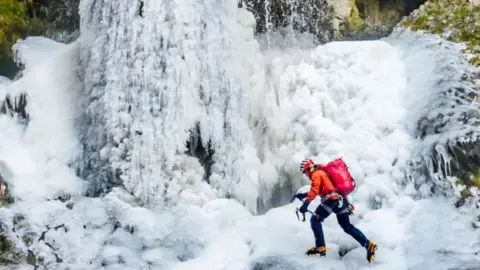
On Wednesday, a volunteer mountain rescuer was pictured scaling a frozen Gordale Scar waterfall in the Yorkshire Dales National Park after temperatures dropped.
“I’ve done it probably three times in the last six years,” said Mick Ellerton, an experienced climber. “It very rarely comes into (the right) conditions”.
The BBC heard from one man who said he was driving “very carefully” with his wife, on the A887 to Edinburgh, when a tree suddenly fell on their car.
“It was quite unbelievable,” said Gerard Cairney, adding that the tree “bounced” off his bonnet. He was able to swerve, avoiding any serious damage, bar some minor scratches on the paintwork.
Where are the weather warnings?
Amber warnings for heavy snow are in place in the following areas from 20:00 GMT Thursday to 09:00 on Friday:
- The Midlands
- Wales
- South West England
- Yorkshire & Humber
An amber warning for strong wind has also been issued from 16:00 – 23:00 Thursday in parts of South West England:
- Cornwall
- Isles of Scilly
Yellow weather warnings for snow, ice and rain are also in place for the following areas:
- Scotland (snow and ice) – 22:00 Wednesday – 12:00 Thursday
- Devon and Somerset (snow) – 20:00 Thursday – 09:00 Friday.
- The Midlands, Yorkshire, Wales, North West and South West England, North East England, East of England, London and South East England (snow) – 17:00 Thursday – 12:00 Friday.
- Northern Ireland (ice) – 00:00 – 10:00 Thursday
- Lincolnshire and parts of East of England including Cambridgeshire, Norfolk, Peterborough and Suffolk (rain) – 18:00 Thursday – 21:00 Friday
- London and South East England, Pembrokeshire in Wales and South West England (wind) – 15:00 Thursday to 06:00 Friday.
The snow and icy conditions have also caused widespread travel chaos across Europe, with thousands of people stranded at airports in Paris and Amsterdam as flights were cancelled.
At least six people have died in weather-related incidents across Europe this week – five in France and one in Bosnia.
 PA Media
Cold Weather Payments
Over the past week, an Arctic blast has seen temperatures between 4 and 10C below the January average.
The UK Health Security Agency (UKHSA) has issued amber cold health alerts for England which will run until Sunday.
Low temperatures have already triggered the government’s cold weather payments across at least 697 postcodes in England, Wales and Northern Ireland. It means that more than one million households will receive money.
Under the scheme, households on certain benefits receive £25 automatically if the temperature in their local area is recorded or forecast as 0C or below for seven consecutive days.
The money is paid automatically into a bank account within 14 days.
A separate winter heating payment system, operates in Scotland.